Trading, The Boring Trendline System Behind a $526,454 Track Record
Need articles like this for your video? They help promote it on YouTube and Google — order them in the Telegram bot @sat_sit_bot. The bot writes and publishes the articles itself (with your YouTube video embedded) on popular topical websites (no ads). Try it free: 50 articles on us.
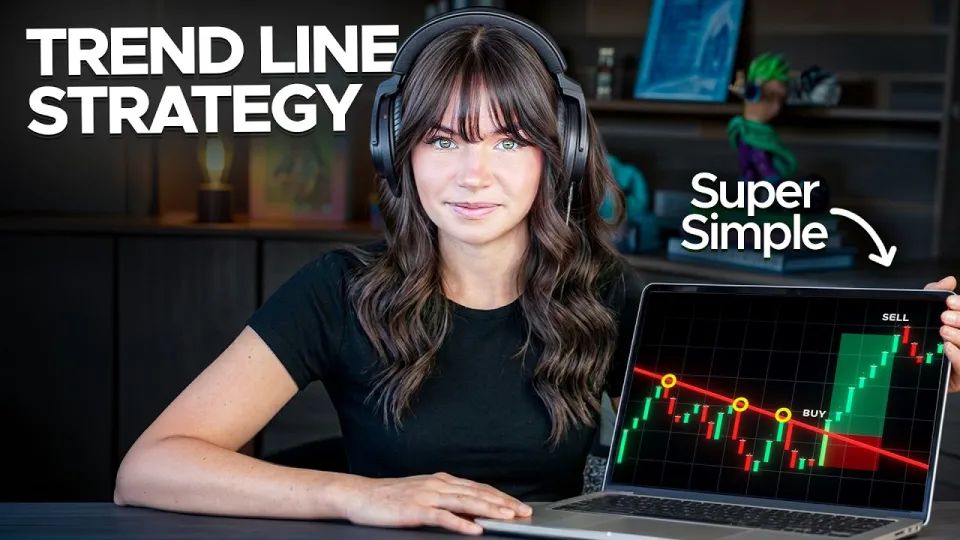
Trading with nothing but trendlines is a complete, rule-based method: you mark the swing highs and lows on a higher time frame, draw an upper and a lower line, and only act when price breaks the Action Line with the Safety Line defining your risk. Tori Trades, the futures and forex trader behind the Tori Trades channel, says this same system has been used for over 11 years and produced $526,454, and she teaches it as a repeatable process rather than a set of predictions. You can join the waitlist for her trading programme to see the full framework.
What the boring trendline trading strategy actually is
The strategy is a two-line channel: one trendline drawn along the swing highs, one along the swing lows, with each line given a job before any trade is taken. The upper or lower boundary of the channel acts as the Action Line — the price level whose break signals that a move is starting. The opposite side of the channel acts as the Safety Line — the level that invalidates the idea and therefore holds the stop. Nothing else is on the chart: no moving averages, no RSI, no volume profile, no order blocks. The trader's argument is that a system with two lines and two rules removes the moment-to-moment interpretation that causes most losses, and that is precisely why it has survived more than a decade of changing markets.
Top-down analysis: how to read any chart before drawing a line
Top-down analysis means you start on the highest time frame you intend to trade and work downward, so that every line you draw has context. The sequence is:
- Identify the dominant trend on the higher time frame — higher highs and higher lows, or lower highs and lower lows.
- Mark the significant swing points that produced those extremes; ignore minor wicks and one-bar spikes.
- Draw the provisional trendlines connecting at least two, ideally three, of those swings.
- Drop to a lower time frame only to refine the placement of the same lines, not to invent new ones.
- Wait for price to reach a line; the middle of the channel is a no-trade zone.
The last point is the discipline test. Most of the time the correct action is to do nothing, because price is between the lines. Entries happen at the edges, not in the middle.
Rules for drawing trendlines correctly
A trendline is only useful if two different people would draw it in the same place, so the rules are mechanical. Connect swing lows to swing lows for an uptrend and swing highs to swing highs for a downtrend, using the extremes of the candles rather than the closes. Never force a line through price that does not touch it — if the third touch requires bending the line, the trend is weaker than it looks. A line touched twice is a hypothesis; a third touch confirms it. Steep lines break quickly and are less reliable than lines at a moderate angle, and a line that has been respected for many bars carries more weight than a fresh one. When price closes decisively through a line, the line is redrawn or discarded rather than defended.
Action Line, Safety Line and the entry trigger
The Action Line is the trendline whose break you trade; the Safety Line is the trendline that tells you the trade is wrong. In an uptrend, the upper line is the Action Line and the lower line is the Safety Line: a close above the Action Line is the entry signal, and the Safety Line sits below the structure as the invalidation point. In a downtrend the roles reverse. The entry is taken on the break, not in anticipation of it, which means you give up some of the move in exchange for confirmation. If price breaks the Action Line and immediately closes back inside the channel, the setup has failed and there is no trade — the break must hold.
Position sizing, stop-loss and trailing the Safety Line
Risk is defined by the distance between your entry and the Safety Line, so the stop is placed just beyond that line and the position size is derived from it. If the entry-to-stop distance is wide, the position is smaller; if the lines are close together, the position can be larger for the same dollar risk. This keeps the loss on any single trade constant as a percentage of the account regardless of the market or the time frame. As the trade progresses, the Safety Line is trailed — moved in the direction of the trade behind each new swing — so that an open profit is protected and a winner is never allowed to become a loser. The line is only moved when a new swing forms, never arbitrarily.
Typical questions and doubts from traders
Beginners usually ask whether the method works on small accounts, and the answer is that position sizing scales to any balance because risk is set as a percentage rather than a fixed contract count. Experienced traders who have spent months on complex smart-money concepts often ask why the simple version feels too easy; the reason is that the difficulty is in the waiting, not in the drawing. Others want to see a live order placed with a specific broker and leverage, which is a fair request — the mechanics of execution matter, and the framework is best learned alongside a real platform. A common worry is that trendlines are subjective; anchoring them to confirmed swing points, and requiring a third touch, removes most of that ambiguity. The most frequent question of all is about patience: sitting out the middle of the channel is the part that makes the system profitable, and it is the part most people skip.
Tools and links from the video
- Waitlist for the trading programme
- Tradezella trade journal — discount code TORI20 on the yearly plan
- TradeStation broker
Summary
Tori Trades' trendline system is deliberately unglamorous: two lines, a top-down read, an Action Line for entries and a Safety Line for stops and trailing exits. Its edge comes from consistency and risk control rather than from prediction, which is why the same rules have reportedly held for over 11 years and $526,454 in results. Draw the lines on the higher time frame, size the position from the distance to the Safety Line, and spend most of your time waiting in the middle of the channel. The full breakdown is on the Tori Trades channel, and you can join the waitlist here to go deeper into the framework.
Key takeaways
- Tori Trades has used the same trendline system for over 11 years and reports $526,454 in profits from it.
- The method uses no indicators: only swing highs and lows, two trendlines per setup, and a top-down multi-timeframe read.
- The Action Line defines entry when price breaks it; the Safety Line defines the stop and later the trailing exit.
- Position size is calculated from the distance between entry and Safety Line, not from a fixed lot or contract count.
- Charts are analysed from the higher time frame down, then lines are refined on lower time frames for execution.
Source: This boring trading strategy made me $526,454 · Markdown version
Questions & answers
Does the trendline strategy work without any indicators?
Yes. The method relies only on swing highs, swing lows and two drawn lines, so there are no indicator settings to optimise and no lagging signals. Everything is decided by whether price breaks the Action Line and holds above or below it, with the Safety Line defining the risk.
Can a small account trade this system?
Position size is calculated from the distance between entry and the Safety Line, so risk is a percentage of the account rather than a fixed number of contracts. A small balance simply produces a smaller position, which is why the framework scales across account sizes and markets.
How do you avoid drawing trendlines that are purely subjective?
Anchor lines only to confirmed swing points and require a third touch before treating a line as valid. If the line has to be bent to fit price, it is discarded. Following the same rules each time means two traders looking at the same chart should place the lines in roughly the same spot.
What happens if price breaks the Action Line and then reverses?
The break must hold; if price closes back inside the channel straight after breaking the Action Line, the setup is invalid and no trade is taken. If you are already in, the Safety Line is the invalidation level, and it is trailed behind new swings so an open profit is protected.