How to turn a single meme coin trade into a five-figure payout with a disciplined entry and exit plan
Need articles like this for your video? They help promote it on YouTube and Google — order them in the Telegram bot @sat_sit_bot. The bot writes and publishes the articles itself (with your YouTube video embedded) on popular topical websites (no ads). Try it free: 50 articles on us.
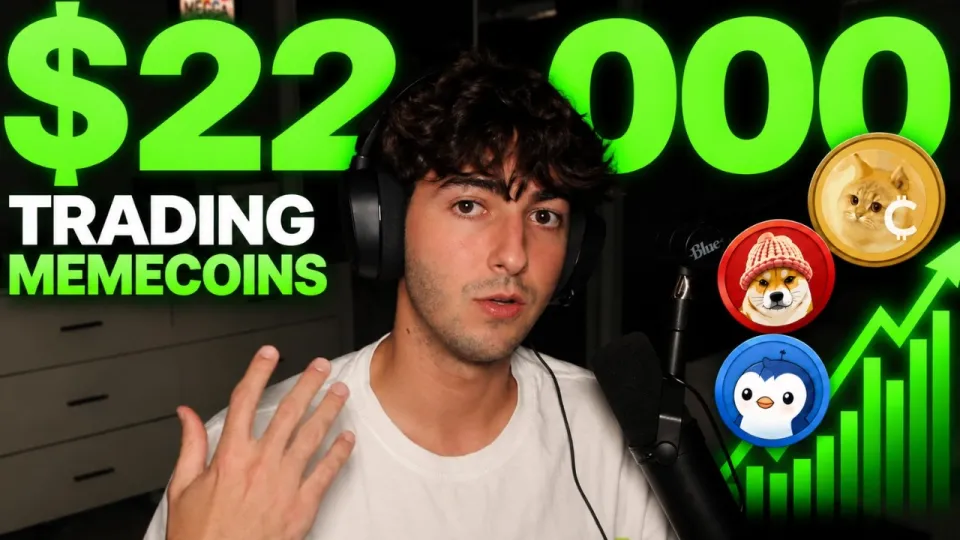
A $22,000 result from one meme coin trade is not the product of a lucky click; it is the output of a repeatable process that starts with wallet hygiene, moves through on-chain screening, and ends with a pre-planned exit ladder. The breakdown published by Megga on 11 September 2026 walks through exactly that sequence, from opening a self-custody wallet to closing a single position at a five-figure profit, and points beginners to a free beginner guide on Whop before they risk any capital.
What the $22,000 meme coin trade actually involved
The trade was a single spot position in one meme coin, not a leveraged bet and not a portfolio of dozens of tokens. That distinction matters: a five-figure outcome from one position means the position was sized large enough to matter, which also means the downside was real. Megga frames the result as a guide rather than a flex, and the structure of the video follows the order of operations a trader needs to survive long enough to catch a runner: wallet setup, token discovery, due diligence, entry, and exit.
Meme coins on Solana trade in seconds and can move 50% in a minute, so the mechanics of execution are as important as the thesis. That is why the workflow leans on a dedicated terminal instead of a slow interface: speed of entry and exit is part of the edge.
Step-by-step: the meme coin workflow behind the result
A repeatable meme coin process has five stages, and skipping any one of them is how most traders turn a winner into a loss.
- Set up a dedicated wallet. Use a fresh self-custody wallet funded only with capital you can lose. Keep it separate from long-term holdings, and never sign transactions from a wallet that holds serious balances.
- Fund with a small, fixed bankroll. Decide the total amount you are willing to risk on meme coins before you look at a single chart. Megga's approach treats each trade as one slice of that bankroll, not as the whole thing.
- Screen the token before buying. Check liquidity depth, holder count and distribution, the age of the pool, whether mint and freeze authorities are revoked, and whether top wallets are clustered. A token with a handful of wallets holding most of the supply is a rug waiting to happen.
- Read the social layer. Meme coins are attention markets. Look at whether the community is organic or bot-driven, whether the same accounts are shilling every launch, and whether there is a narrative that can travel beyond one Telegram group.
- Execute with a plan. Enter in one or two clips, set a mental (or actual) invalidation level, and define your exit ladder before the price moves.
Screening a meme coin before you buy
The screening stage is where most losses are avoided, because the cheapest trade is the one you never take. On Solana, the basic safety checklist is short but non-negotiable: liquidity should be deep enough that your own sell order does not crater the price; the contract should have no mint authority left active; and the holder list should not show a single wallet controlling a large share of supply.
Beyond safety, look at momentum quality. A token that has already run several multiples before you find it is a different trade from one that is early in its attention cycle. Megga's framing is that the entry should come from a thesis you can state in one sentence, not from a green candle on a screen. If you cannot explain why the token should attract new buyers after you buy, you are the exit liquidity.
Position sizing and the exit ladder
A $22,000 profit implies a meaningful position, but the guide's logic is that size is determined by risk, not by conviction. A common structure is to risk a fixed small percentage of the meme coin bankroll per trade, so that a total loss on one token does not end the experiment. That is the difference between a trader who can take ten shots and one who is out after two.
Exits are planned in stages. Selling a portion into the first strong move locks in realised profit and removes the emotional pressure that leads to holding through a reversal. The remainder can be trailed against structure, with a hard rule that the position is closed if the original thesis breaks. The failure mode the guide warns against is the round trip: a position that was up five figures and is closed at break-even because no exit was ever defined.
Typical doubts from traders watching this result
The most common pushback on a five-figure meme coin result is that it cannot be replicated without a following, a private group, or insider information. That concern is fair and worth stating plainly: a trader with an audience gets earlier access to attention, and early access is a genuine advantage in a market priced on attention. Traders without that network should assume slower entries, smaller size, and a higher chance of buying after the easy move.
The second recurring doubt is about the bankroll. Many viewers want to know whether the same process works starting from $25 or $100. Mechanically it does, but the maths changes: fees, slippage and gas eat a larger share of a tiny position, and the psychological pressure of compounding a small balance pushes traders into oversized bets. Treat a small account as a training ground for process, not as a lottery ticket.
The third is tooling. Questions about trading tokenised social assets and community coins come up constantly, and the honest answer is that each category has its own mechanics, liquidity profile and failure mode. Learn one category thoroughly before adding another; the workflow above transfers, but the specific risks do not.
Tools and links from the breakdown
- Free beginner guide on Whop — the starting resource recommended for newcomers before their first trade.
- Padre trading terminal — the execution interface used for fast entries and exits.
- Twitch — live trading sessions.
- TikTok — short-form clips and recaps.
- Twitter/X — trade commentary and updates.
Conclusion
A single meme coin trade producing $22,000 is a story about process compounding into one good outcome, not a promise that the same number is repeatable on demand. The transferable parts are unglamorous: a separate wallet, a fixed bankroll, a screening checklist, staged exits, and the discipline to accept that most attempts will not be the one. Megga's breakdown is useful precisely because it treats the result as the end of a chain of decisions rather than the beginning of one. Start with the free beginner guide, paper-trade the workflow, and only then put real capital behind a single meme coin position.
Key takeaways
- Megga reports a $22,000 profit from one meme coin position, documented in a step-by-step guide published on 11 September 2026.
- The workflow relies on Solana-based tools: a self-custody wallet plus a trading terminal such as Padre for fast execution.
- Screening happens before buying: liquidity, holder distribution, contract safety and social traction are checked first.
- Risk is capped by sizing one position as a small slice of the portfolio and pre-planning exits rather than holding for a dream multiple.
- A free beginner guide is offered at whop.com/wiredd, and the trading terminal link is trade.padre.gg/rk/megga.
Source: How I Made $22,000 in a SINGLE Memecoin Trade (FULL GUIDE) · Markdown version
Questions & answers
How much capital do you need to start trading meme coins?
You can start with a very small amount, but the mechanics favour a bankroll large enough that fees and slippage do not dominate the result. A practical approach is to fund a separate wallet with money you can afford to lose entirely, then risk only a small slice of that per trade. Treating a tiny balance as a lottery ticket usually leads to oversized bets and rapid losses.
Is a $22,000 meme coin trade realistic for a beginner?
The number itself is an outlier outcome, not a typical result. It reflects a position sized meaningfully and an exit executed into strong demand, which requires both a working process and favourable timing. Beginners should measure success by whether they followed their screening and exit rules, not by whether they matched a five-figure profit.
What should be checked before buying a new meme coin?
Verify that liquidity is deep enough for your order size, that mint and freeze authorities are revoked, and that supply is not concentrated in a few wallets. Then assess the social layer: organic discussion versus coordinated shilling, and whether there is a narrative that can attract new buyers. If you cannot state the thesis in one sentence, skip the trade.
Why do traders with large followings seem to win more often?
An audience provides earlier access to attention, and meme coin prices are driven by attention. That is a structural advantage that a trader without a network cannot fully replicate. The realistic response is smaller position sizes, stricter screening, and accepting that you will often enter later in the move than a well-connected trader does.